¶ Air-to-Ground Manual
Task Force Jackal
A2G
Purpose: Fundamental principles and guidance for planning, coordinating, and executing close air support, transport, and surveillance during operations.
¶ 1 — Scope
This document provides fundamental principles and guidance to plan, coordinate, and execute close air support, transport and surveillance during operations.
¶ 2 — Purpose
This document sets forth joint doctrine to govern the activities and performance of Task Force Jackal in its operations. It provides military guidance for the exercise of authority by TOC and other leadership elements and prescribes joint doctrine for operations, education, and training. It provides military guidance for use by Joint Terminal Attack Controllers (JTAC) in preparing their appropriate plans.
¶ 3 — Application
The guidance in this publication is authoritative; as such, this doctrine will be followed except when, in the judgment of the commander, exceptional circumstances dictate otherwise.
If conflicts arise between the contents of this publication and the contents of prior publications, this publication will take precedence.
Task force command should follow doctrine and procedures ratified by the United Kingdom & NATO in order to ensure unity of effort in the accomplishment of the overall objective.
“Among military men it is commonplace that interallied and interservice operations inescapably pose grave difficulties in execution. Differences in equipment, in doctrine, in attitude and outlook stemming from contrasting past experience all inhibit and complicate harmonious interaction. Past successes, however, have shown that these difficulties can be overcome where determination is present and effective procedures have been applied by properly trained troops. Experience also shows that armed forces . . . have been slow to hammer out the necessary procedures. Often corrective steps have been achieved only after many failures in battle. In no area of interservice operations has this phenomenon been more pronounced than in the matter of close air support.”
— Professor I. B. Holley, Jr.,
Case Studies in the Development of Close Air Support
Office of Air Force History, 1990
¶ 4 — Requirements
Alongside completing the Basic Radio User course you must meet the following to be considered for a JTAC position:
-
ACRE: You must be able to use ACRE to a high standard and understand additional channel setups.
-
SA: You must be able to utilise a radio while also being aware of your surroundings, as well as recording and alerting others to incoming threats.
-
Adapt: You must be able to think on the spot and adapt to situations when they arise.
-
Maps: You must be able to use a map, map tools and understand the terrain around you.
¶ 5 — Understanding Chain of Command (COC)
A JTAC must understand their place within the squad, as well as within the overall combat environment. It must not be overlooked that the JTAC always answers to their squad leader and TOC, never the other way around.
¶ 6 — Transport
¶ 6.1 — Holding Point (HP)
HPs can be used to assign an aircraft to a designated location in order to temporarily hold their position before proceeding further.
¶ 6.2 — Initial Point (IP)
IPs are specific and predefined geographic locations in the vicinity of an AO or target area from which a RW or FW aircraft begins its approach and ingress to that area.
¶ 6.3 — Release Point (RP)
RPs are predetermined locations where an aircraft releases from its formation with another aircraft to follow its own specific route. The standard distance an RP should be from an LZ is roughly 500 m to give ample time for pilots to adjust their speed and heading. An example of when this would be used could be; two little birds flying into 2 separate LZs on either side of a road. When passing the RP on a flight path the flight lead should call “passing RP X”.
¶ 6.4 — Helicopter Landing Zones (HLZ)
HLZs are specific locations used to designate where a RW aircraft should land, they can be any position but should at minimum support the type of helicopter being used to land on them.
If enemy contact is expected then a “Hot LZ” call should be transmitted on net
If fire is being received when landing at a HLZ, the best course of action is to return self-defence fire using on-board weaponry. Due to the known fact that the LZ is hot, the mission may depend on the helicopter making it onto the HLZ, at all costs, and therefore a wave-off should only be considered if the crew has sustained injuries or aircraft loss is expected.
¶ 7 — Formations
¶ 7.1 — Communication
Effective radio communication is essential between the lead helicopter and the rest of the flight to ensure coordination and alignment. The lead pilot should notify the flight of changes in; speed, altitude, direction and spacing. For example, when the flight lead is increasing their speed the flight should be notified: “one, increasing speed to 8-0”. If at any point an aircraft needs to break formation, it should be called: “two, breaking off” and that aircraft should at the nearest convenience rejoin the formation at the rear.
¶ 7.2 — Trail
Similar to the infantry column, a trail formation is where two or more aircraft follow each other, one after another in a single file. This formation is typically used when the flight needs to maintain a low profile and/or has little room to maneuver. An example could be flying along a river, due to the amount of bends it is much easier to follow rather than maintain linear spacing during multiple turns. The lead helicopter is responsible for navigation and obstacle avoidance. The following helicopters should maintain a steady course, adjusting their position as needed to stay in the trail.
¶ 7.3 — Echelon Left & Right
An echelon formation is a tactical arrangement where the flight follows each other in a diagonal line with each helicopter positioned to the left (or right) and slightly behind the helicopter in front of it. The echelon provides improved visibility to the left (or right) and forward of the formation which is important for maintaining situational awareness.
Trail Echelon Right Echeclon Left
¶ 8 — CAS
¶ 8.1 — Introduction to CAS
Close air support (CAS) is a critical element of joint fire support that requires detailed planning, coordination, and training of ground and supporting air forces for safe and effective execution. Based on threats and the availability of other means of fire support or supporting arms, synchronizing CAS in time, space, and purpose with supported ground forces may be the most detailed and continuous integration task performed by the task force. CAS is a key capability to employ fires that destroy, suppress, or neutralize enemy forces and in turn permit movement and maneuver and enable control of territory.
While the focus of this document is on CAS operations, these tactics, techniques, and procedures (TTPs) may be used for non-CAS missions that require terminal attack control (TAC) but do not require detailed integration with the fire and movement of ground force assets.
¶ 8.2 — Close Air Support Overview
CAS is air action by fixed-wing (FW) and rotary-wing (RW) aircraft against hostile targets that are in close proximity to friendly forces. It requires detailed integration of each air mission with the fire and movement of those forces. All fires should support the objectives, guidance and priorities of the mission.
CAS is planned and executed to support ground tactical units. CAS execution is tightly integrated at the tactical level with the fire and maneuver of supported ground forces. The proportion and allocation process for CAS occurs at the operational level. CAS planning focuses on providing timely and accurate fires in support of friendly forces in close proximity to the enemy.
¶ 8.3 — Types of Control
JTACs have the authority to control the maneuver of and grant weapons release clearance to attacking aircraft. A certified and qualified joint terminal attack controller (JTAC) will be recognized as capable and authorized to perform CAS. There are three types of control (Types 1, 2, and 3).
Close Air Support Terminal Attack Attributes
| Type | Attributes | JTAC observes target and aircraft | Timely and accurate target data provided |
|---|---|---|---|
| 1 | Clearance required for each attack. JTAC maintains abort authority. | Required¹ | By JTAC (inherent to Type 1 control) |
| 2 | Clearance required for each attack. JTAC maintains abort authority. | Not required² | By JTAC, observer, or through other JTAC sensors³ |
| 3 | Blanket clearance provided by JTAC within prescribed guidance and subject to specific attack restrictions. JTAC maintains abort authority. | Not required² | By JTAC, observer, or through other JTAC sensors³, if targets comply with prescribed guidance⁴ |
Notes:
1JTAC will visually acquire the attacking aircraft and analyze attack geometry to reduce the risk of the attack affecting friendly forces.
2Warning: Even though the JTAC is not required to observe the aircraft and/or target during Type 2 / 3 controls, if able the JTAC should do so in order to provide an additional measure of control to abort the attack if necessary.
3Observer: JFO, Scout, UAS, SOF, aircrew, or assets that provide real-time targeting information.
4Supported commander delegates weapons release authority to the JTAC for all types of control. JTAC will provide “cleared hot” as appropriate for each attack in Type 1 and 2 controls and “cleared to engage” for Type 3 control.
¶ 8.3a — Type 1 Control
Type 1 control is used when the JTAC requires control of individual attacks and the situation requires the JTAC to visually acquire the attacking aircraft and visually acquire the target for each attack.
¶ 8.3b — Type 2 Control
Type 2 control is used when the JTAC requires control of individual attacks and is unable to visually acquire the attacking aircraft at weapons release OR visually acquire the target.
¶ 8.3c — Type 3 Control
Type 3 control is used when the JTAC requires the ability to provide clearance for multiple attacks within a single engagement subject to specific attack restrictions, no visual on target or aircraft is required, but may be situationally recommended.
¶ 8.4 — Initial Points and Battle Positions (IPs & BPs)
¶ 8.4a — Initial Point
The Initial Point is the geographic point at which the aircraft starts the final approach to the target. The IP is used for timing, orientation, and ensuring the aircraft is on the correct flight path. The IP is often a significant landmark, such as a hill or a man-made structure, that is easy to recognize both on a map and visually from the air.
¶ 8.4b — Battle Position
The Battle Position is a predefined point in space where the attack aircraft will orbit or hold while awaiting further instructions to attack. The BP is generally located at a safe distance from the target and enemy defenses but close enough to permit rapid engagement once the decision to attack has been made.
¶ 8.5 — The Overhead
“From the overhead.”: The overhead is an attack from an orbit over the target area. In a 7 line, if an aircraft is in the overhead, replace line 1 & 2 with either “From the overhead” or “Lines 1 & 2 N/A”.
¶ 8.6 — Offset Direction
The offset direction tells the aircrew on which side of the IP-to-target line they can maneuver for the attack (see Figure I). JTACs use an offset direction to align the aircraft for the attack or egress, or keep aircrews away from known threats.
¶ 8.7 — Final Attack Headings (FAH)
¶ 8.7a — Purpose
Controllers may employ FAHs/windows that allow aircrews to maneuver on either side of the attack heading. This gives aircrews more flexibility in prosecuting the target while maintaining the required degree of restriction on the aircraft heading. Attack headings also allow RW aircraft to maneuver over terrain to enhance delivery while remaining survivable.
¶ 8.7b — Utilisation
JTACs assign attack headings for several reasons: to increase ground troop safety, aid in aircraft acquisition by the JTAC, aid aircrews in target acquisition, mitigate collateral damage, meet laser restrictions and facilitate fire support coordination. If the JTAC requires a specific attack heading for the weapon (but not the aircraft), that restriction must be stated clearly when the FAH is passed.
¶ 8.7c — Note
JTACs must weigh the advantages of issuing an attack heading with the disadvantages of restricting aircraft tactics. Final attack headings are not issued when there is no requirement. JTACs should attempt to place as few restrictions as possible on attacking aircraft. Unnecessary or overly restrictive run-in restrictions often increase the time required to attack, decrease the flexibility and survivability of the flight, and increase the likelihood of an aircraft not expending its ordnance because it was outside of parameters. JTACs should limit restrictions to the minimum required; however, any final attack geometries provided as part of the CAS briefing in the form of headings, and/or directions are by definition “restrictions” and therefore must be read back. The following are examples of briefed final attack geometry:
-
Magnetic Heading. “Final attack heading 030.”
-
Magnetic Headings With Cone. “Final attack heading 240-300” or “Final attack heading 270 plus-or-minus 30 degrees.”
-
Use of a geographical reference. Use of a geographical reference: JTAC states “Make all attacks parallel to the road.”
¶ 8.8 — Mark Types
¶ 8.8a — Marks
A target mark should be provided for CAS aircraft whenever needed. Target marks should be planned to include sufficient time for CAS aircrews to observe them prior to employment. JTACs should strive to provide redundant marks when deemed necessary in case the primary mark fails, is late, or is inaccurate during the final phases of an attack. Examples of redundant mark combinations are laser/smoke, IR pointer/tracer and smoke/talk-on. The target mark can also be provided by direct or IDF weapons (heavy machine gun tracer, 40 mm, mortars or artillery) or an airborne platform such as a FAC(A). See Figure II for standard marking brevity terms.
¶ 8.8b — Talk-on
When one of the above marking methods is not possible, the CAS target may be identified by narrative description provided by the JTAC. This is known as a “talk-on” to target. The JTAC marking their position with devices such as strobe lights or IR lasso may aid this narrative. Extreme care must be taken to not highlight friendly ground forces positions to the enemy.
Figure II — Standard Marking Brevity Terms
| Term | Meaning |
|---|---|
| Blind | No visual contact with FRIENDLY aircraft/ground position. Opposite of VISUAL. |
| Visual | Sighting of a FRIENDLY aircraft or ground position. Opposite of BLIND. |
| Contact “x” | Acknowledges sighting of a specified reference point, either visually or via sensor. |
| (Target / Object) Captured | Specified surface target or object has been acquired and is being tracked with an onboard sensor. |
| Looking | Aircrew does not have the ground object, reference point, or target in sight. Opposite of SEEN / EYES ON. |
| Tally | Sighting of a target, nonfriendly aircraft, or enemy position. Opposite of NO JOY. |
| No Joy | Aircrew does not have visual contact with the TARGET/BANDIT. Opposite of TALLY. |
¶ 8.9 — Target Reference Points
¶ 8.9a — Utilisation
TRPs are generated by labeling buildings or distinctive urban structures in and around the objective area. These can be labeled TRP#1, TRP#2, etc. TRPs expedite passing or interpreting a call for fire. If fire is being received, pass a TRP number, heading, approximate distance, and description of where and what type of fire is being received. Reference Figure III.
¶ 8.9b — CTAB
TRPs can also be generated by using a marker on the CTAB system. This is generally to provide a more accurate position of the target if there are no urban landmarks to reference.
Figure III
“TRP #3, heading 030 degrees, distance 325 meters, reference water tower.”
¶ 8.10 — Restricted Operating Zones (ROZ)
¶ 8.10a — Utilisation
In the context of CAS an ROZ is a designated airspace within which specific restrictions or limitations are imposed to ensure the safety and effectiveness of CAS missions. These restrictions are put in place to protect friendly ground forces and minimize the risk of friendly fire or unintended collateral damage. Aircraft providing CAS may be required to enter and exit the ROZ at designated points. This helps in controlling the flow of aircraft and ensures that they approach the target area from safe directions.
¶ 8.10b — Execution
Typically ROZs will be predefined zones within the AO and will be provided in the operation briefing. However, ROZs can also be improvised by the JTAC mid operation. The size and restrictions applied to an ROZ heavily depend on the scale and capability of the enemy force.
¶ 9 — Execution of CAS
¶ 9.1 — Minimizing Friendly Fire
¶ 9.1a — General
Casualties to friendly forces caused by friendly fire incidents are the occasional tragic consequence of warfare. However, these unwanted incidents can be significantly reduced when all parties involved in the planning and execution of CAS missions make every effort to mitigate the associated risks.
¶ 9.1b — Causes
Although occasionally the result of malfunctioning weapons… or people, friendly fire has often been the result of confusion on the battlefield. Causes include misidentification of targets, inaccurate target locations or descriptions, target locations incorrectly transmitted or received; and loss of situational awareness (SA) by JTACs, CAS aircrews, or commanders. Items such as; detailed mission planning, standardized procedures for supporting immediate air requests, realistic training/mission rehearsal, use of friendly tagging or tracking devices (such as blue force tracker & IR Strobes), effective AO coordination, and sound clearance of fires procedures can significantly reduce the likelihood of friendly fire.
¶ 9.1c — Responsibility
All participants in CAS are responsible for effective and safe planning and execution. Each participant must make every effort to identify friendly units, enemy forces, and civilians prior to targeting, clearing fires, and weapons release. PID is the process of attaining an accurate characterization of detected objects in the operational environment sufficient to support an engagement decision. Depending on the situation and the needed operational decisions, this characterization may be limited to BLUFOR, OPFOR, GRENFOR, or noncombatant. PID characterizations, when applied with ROE, enable engagement decisions to use or prohibit lethal weaponry.
¶ 9.1d — Training
The task force, components, and units should conduct regular joint training and rehearsals that simulate situations in the operational environment; in order to develop the skill sets and familiarity required for success.
¶ 9.2 — Minimizing Civilian Casualties
¶ 9.2a — General
The law of war requires commanders to take all precautions to minimize civilian casualties and collateral damage, while remaining consistent with mission accomplishment and the security of the force. These events are tragic and can have lasting negative operational and strategic effects, such as decisions to restrict future operations.
¶ 9.2b — Causes
Understanding and selecting alternative choices for fires application may offer the best opportunity for reducing the likelihood and impact of civilian casualties.
¶ 9.2c — Responsibility
All participants in the CAS employment process are responsible for the effective and safe planning and execution of CAS, including positive identification (PID). CAS must comply with the law of war and applicable theater ROE.
¶ 9.2d — Training
Pre-deployment preparation and review of current CAS ROE, scenarios, and lessons learned from theater can help minimize civilian casualties.
¶ 9.3 — Steps of CAS
- Routing. (JTAC to Pilot)
- Check In. (Pilot to JTAC)
- Game Plan. (JTAC to Pilot)
- CAS Brief. (JTAC to Pilot)
- Restrictions. (JTAC to Pilot)
- Readbacks. (Pilot to JTAC)
- The Attack. (Pilot to JTAC)
- BDA. (JTAC Provide / Request)
- Routing. (JTAC to Pilot)
¶ Explanation
¶ 1. Routing / Safety of Flight
- Three-dimensional directions from the current aircraft position
to the intended holding point or area. - Holding point and altitude, once established, and which
agency to contact. - Other aircraft on station.
- Surface-to-air threats that may immediately affect close air
support aircraft. - Any other safety of flight issues.
- Pass any gun-target-line information (active or inactive) and
azimuth/location.
¶ 2. CAS Check-in Briefing
- Aircrew: "_________, this is _________."
- Mission number: (if required) "_________."
- Number and type of aircraft: "_________."
- Position and altitude: "______________."
- Ordnance: "______________________."
- Playtime or time on station: "__________."
- Capabilities: "____________________."
(type of sensors, video downlink, SITREPs on board)- Abort code: (if required)"____________."
¶ 3. Situation Update TEFACHR Format
- Threat: "________________________."
General locations of surface-to-air threats not already
covered. - Enemy Situation "__________________."
General enemy disposition, avoid listing grids. Target grids
will be addressed in CAS briefs. - Friendly Update: "__________________."
General friendly situation and scheme of maneuver.
GFC intent. - Artillery: "________________________."
List factor indirect fire assets.
This may include general direction of fire. - Clearance Authority: "________________."
Omit this if the speaker has control.
Define who has authority for brief, stack, mark, and control. - Hazards: "________________________."
Towers, minimum safe altitude, weather,
CBRN and explosives. - Remarks and Restrictions:"____________."
Ordnance restrictions, JTAC capabilities (e.g. laser, infrared)
Intent for aircraft (e.g. CAS, reconnaissance)
Other remarks
¶ 4. Gameplan or 5-line
- Do not transmit the numbers.
Units of measure are standard (metric) unless briefed. - Lines 2, 3 and any restrictions are mandatory readbacks.
- The JTAC may request an additional readback.
¶ 5. 9-line (skip if 5-line)
- Do not transmit the numbers.
Units of measure are standard (metric) unless briefed. - Lines 4, 6 and any restrictions are mandatory readbacks.
- The JTAC may request an additional readback.
¶ 6. Remarks/Restrictions
- Laser to target line (LTL) / pointer target line (PTL)
- Desired type and number of ordnance or weapons effects
(if not previously coordinated). - Surface-to-air threat, location, and type of SEAD.
- Additional remarks (e.g., gun-to-target line, weather, hazards,
friendly marks). - Additional calls requested.
- Final attack headings or attack direction.
- Airspace coordination areas (ACAs).
- Danger close and initials (if applicable).
- Time over target (TOT) / time to target (TTT).
- Post launch abort restrictions (if applicable).
¶ 7. Readbacks
- 5-line: 2, 3 and restrictions mandatory readback.
- 9-line: 4, 6 and restrictions mandatory readback.
- JTAC may request an additional readback.
¶ 8. Target Correlation
- Talk On:
Use plain English to guide the pilot to the correct
target. - Enhanced Target Description:
Provide a detailed description of the target
and confirm that the pilot has the correct target in sight. - Mark:
Apply the mark and confirm the pilot has correct
target in sight. - Video Downlink:
Use video downlink to confirm correct target.
¶ 9. Attack
¶ 10. JTAC allow pilot to push to target
¶ 11. Pilot confirms inbound heading
¶ 12. JTAC clears the engagement
(type-3 requires clearance right after step 8)
¶ 13. Pilot fires with appropriate brevity term for the weapon
¶ 14. Assess Effects
- Call out visual on splash.
- Assess damages and effect.
¶ 11. Battle Damage Assessment
- Total damage.
- Any remaining threats (if required).
- Re-attack or continue to HA/HP?
- If re-attack: request airframe
to re-attack with any adjustments. - If continue to HA/HP: Provide routing and safety
of flight back to HA/HP.
¶ 12. Routing / Safety of flight
- Provide route out of combat area.
- Give safety of flight briefing (Step 1)
Reference: Additional information was linked in the original source.
9.5 Aircraft Check-in Briefing
9.6 Situation Update
Once an aircraft has checked in, the JTAC may provide a
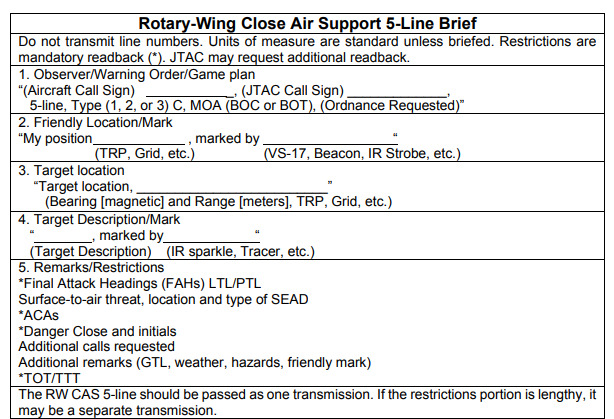
¶ 10 — RW CAS 5 LINE - JTAC SLATE CARD 1
¶ 
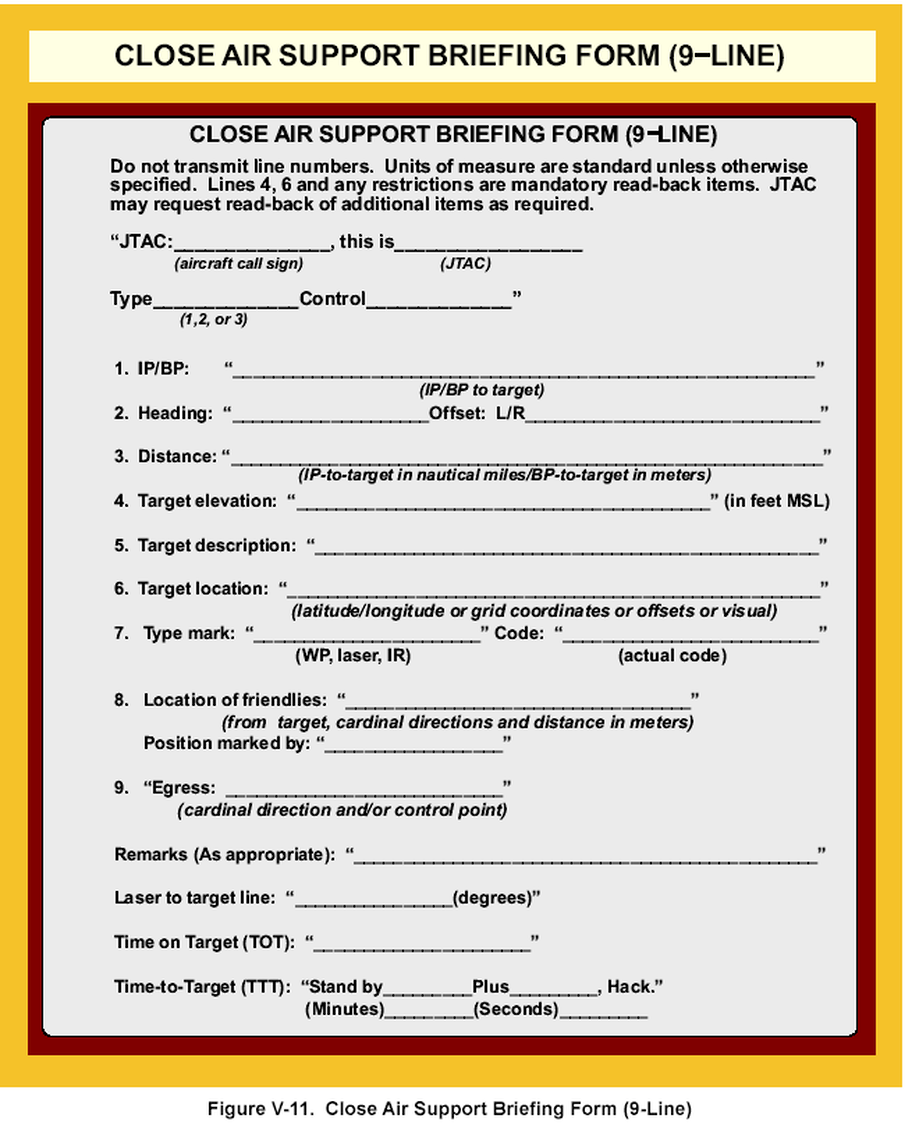
¶ 11 — FW CAS 9 LINE - JTAC SLATE CARD 2
¶ 
¶ 12 — Emergency CAS - JTAC SLATE CARD 3
¶ 12.1 — Perpendicular Attack Headings
Murphy's Law states, ‘Anything that can go wrong, will go wrong’. In the event of a failure or misunderstanding, it is your job to ensure minimal damage is caused. As a JTAC you must protect friendlies to the highest degree possible, especially from your own CAS calls. The simple method to do this is to provide a perpendicular attack heading. This is because the most likely event during a failure is that the munition will continue travelling in a straight line along the final attack heading. You do not want to be in its path.
¶ 13 — ISTAR - JTAC/PILOT SLATE CARD 4
¶ 14 — TRANSPORT - JTAC SLATE CARD 5
¶ 15 — CASEVAC - JTAC SLATE CARD 6
¶ 16 — CHECK IN - PILOT SLATE CARD 1
¶ 16.1 — A/C Check In
Callsign and Type of Aircraft (Mandatory Readback)
Position & Altitude
Ordinance / Pax Capacity (Mandatory Readback)
Playtime
Sensors and Capabilities (FLIR, Spot and Radar)
Abort Code (Mandatory Readback)
¶ 17 — EXAMPLE SCRIPTS
¶ 17.1 — PILOT TO JTAC CHECK-IN
“JTAC CALLSIGN this is PILOT CALLSIGN check-in for you, over"
"JTAC CALLSIGN send, over"
"PILOT CALLSIGN is
1x MH-60 DAP
Currently at BP1 (Battle Position 1), 500 meters of altitude
Ordinance is 8x AGM-114K, 19x Hydra, 300 Rounds of 30 mm
Playtime 1 hour 30 minutes
Capable of FLIR, Spot, Downlink and Radar
Abort Code
Over”
"JTAC CALLSIGN i have
1x MH-60 DAP
BP1 at 500 meters of altitude
8x AGM-114K, 19x Hydra, 300 Rounds of 30 mike mike
1 hour 30 minutes of Playtime
Capable of FLIR, Spot, Downlink and Radar
Over”
"PILOT CALLSIGN good readback, over"
Incorrect readback example:
"PILOT CALLSIGN, wrong, 350 rounds of 30 mike mike, over"
"JTAC CALLSIGN, correction to my last, 350 rounds of 30 mike mike, over"
"PILOT CALLSIGN, good readback, over/out"
And then back to point 5. With good readback
"PILOT CALLSIGN, out”
¶ 17.2 — JTAC TO PILOT TRANSPORT BRIEF
"PILOT CALLSIGN this is JTAC CALLSIGN requesting transport, over"
"PILOT CALLSIGN send, over"
"JTAC CALLSIGN
LZ Grid 012 345
4x Pax (could also request supply crates etc)
Marked by purple smoke
Remarks, Ingress from the East, egress to the North, over
Over"
"PILOT CALLSIGN I have
LZ at grid 012 345
4x Pax
Purple Smoke, over”
"JTAC CALLSIGN, good readback, advise when 30 seconds out, over"
"PILOT CALLSIGN 30 seconds, over"
"Smoke popped" OR "Lasso" OR "Continue" if used negative mark
"Visual smoke" OR "Visual lasso" OR "Copy continue"
Heli lands
"JTAC CALLSIGN, Cleared to dust, over"
"PILOT CALLSIGN Dusting, over"
"JTAC CALLSIGN Out"
¶ 17.3 — TYPE 2 CONTROL 5 LINE BRIEF
"PILOT CALLSIGN, this is JTAC CALLSIGN stand by for CAS brief, over"
"PILOT CALLSIGN send, over"
"JTAC CALLSIGN CAS brief as follows
Type 2 control
Bomb on target
1x AGM-114K OR Ordinance at your discretion
Target is 1x tank in the open, approximately 400 meters, West of my location
Friendly location is grid 138 113
On my lase, laser is hot, over"
"PILOT CALLSIGN
Target is 1x Tank in the open 400 m west marked by laser
Friendlies are at grid 138 113
Over"
"JTAC CALLSIGN good readback, advise when in hot, over"
"PILOT CALLSIGN in hot, over"
"JTAC CALLSIGN Cleared hot, over"
"PILOT CALLSIGN, Rifle"
Strike misses
"JTAC CALLSIGN BDA 0/100, repeat strike, adjust 2 0 meters south over"
Note: Do not use “right” and “left” of target as this is relative, always use a cardinal direction i.e., North, East, South, West
Strike hits
"JTAC CALLSIGN BDA 100/100, good strike, out"
¶ 17.4 — TYPE 3 CONTROL 5 LINE BRIEF
"PILOT CALLSIGN, this is JTAC CALLSIGN stand by for CAS brief, over"
"PILOT CALLSIGN, send, over"
"JTAC CALLSIGN, CAS brief as follows
Type 3 control
Bomb on target
Ordinance pilot discretion
Friendly location is grid 138 113
Target area is town at grid 123 575,
Negative damage to civilian structures, over"
"PILOT CALLSIGN i have
Type 3 control
Ordinance my discretion
Target area is town at grid 123 575
Friendlies are at grid 138 113
Negative damage to civilian structures, over"
“JTAC CALLSIGN good readback, over"
Note: Pilot is instantly cleared hot… unless the attack needs to be delayed. in this case JTAC would state “JTAC CALLSIGN good readback, wait for my call, over” and then “Cleared hot, over”
PILOT CALLSIGN begins engaging
“PILOT CALLSIGN, rifle”
“PILOT CALLSIGN shack tank, over”
“JTAC CALLSIGN, Cease fire, over”
“PILOT CALLSIGN, Copy cease fire, over”
“JTAC CALLSIGN, Out”
¶ 17.5 — PILOT TO JTAC ISTAR REPORT
"JTAC CALLSIGN, this is PILOT CALLSIGN, ISTAR, over"
"JTAC CALLSIGN send, over"
"PILOT CALLSIGN has
In the town at grid reference 213 231
1x T-72, 3x Sections of infantry, 4x Technical 2x ZSU-23
Stationary
Over”
"JTAC CALLSIGN
1x T-72, 3x Sections of infantry, 4x Technical 2x ZSU-23
Stationary
In the town at grid reference 213 231
Over”
"PILOT CALLSIGN good readback, over"
"JTAC CALLSIGN continue to monitor, over”
"PILOT CALLSIGN, roger, out"
Note: Alternatively JTAC could then formulate a CAS brief from this ISTAR "PILOT CALLSIGN this is, JTAC CALLSIGN, CAS brief to follow”
¶ 17.6 — JTAC TO PILOT ISTAR REQUEST
"PILOT CALLSIGN, this is JTAC CALLSIGN, ISTAR Request, over"
"PILOT CALLSIGN, send, over”
“JTAC CALLSIGN
I have Mortar fire to my east approximately 1 click
My position is grid 102 032
Over”
“PILOT CALLSIGN, roger searching, out”
“JTAC CALLSIGN this is PILOT CALLSIGN, ISTAR Report, over”
JTAC CALLSIGN will use ISTAR REQUEST